Groundworks in Croydon
We bring industrial-grade engineering to Croydon's urban center. Specialized in tight-access London Clay basements, commercial piling, and surface water drainage for CR0.
Engineered for Urban Builds
Croydon is a tale of two geologies: heavy clay in the north (Thornton Heath) and chalk in the south (Purley). We adapt our piling and foundation strategies to suit the exact density and soil of your postcode.
The North-South Divide
Croydon sits on a major geological boundary. North of the flyover (Broad Green, Selhurst), we deal with deep London Clay. This soil expands and contracts significantly with moisture changes, posing a risk of heave to standard foundations.
To the south (Sanderstead, Purley), the ground shifts to Chalk. While this offers better load-bearing, it requires careful investigation for dissolution features (voids) before heavy loads can be applied.
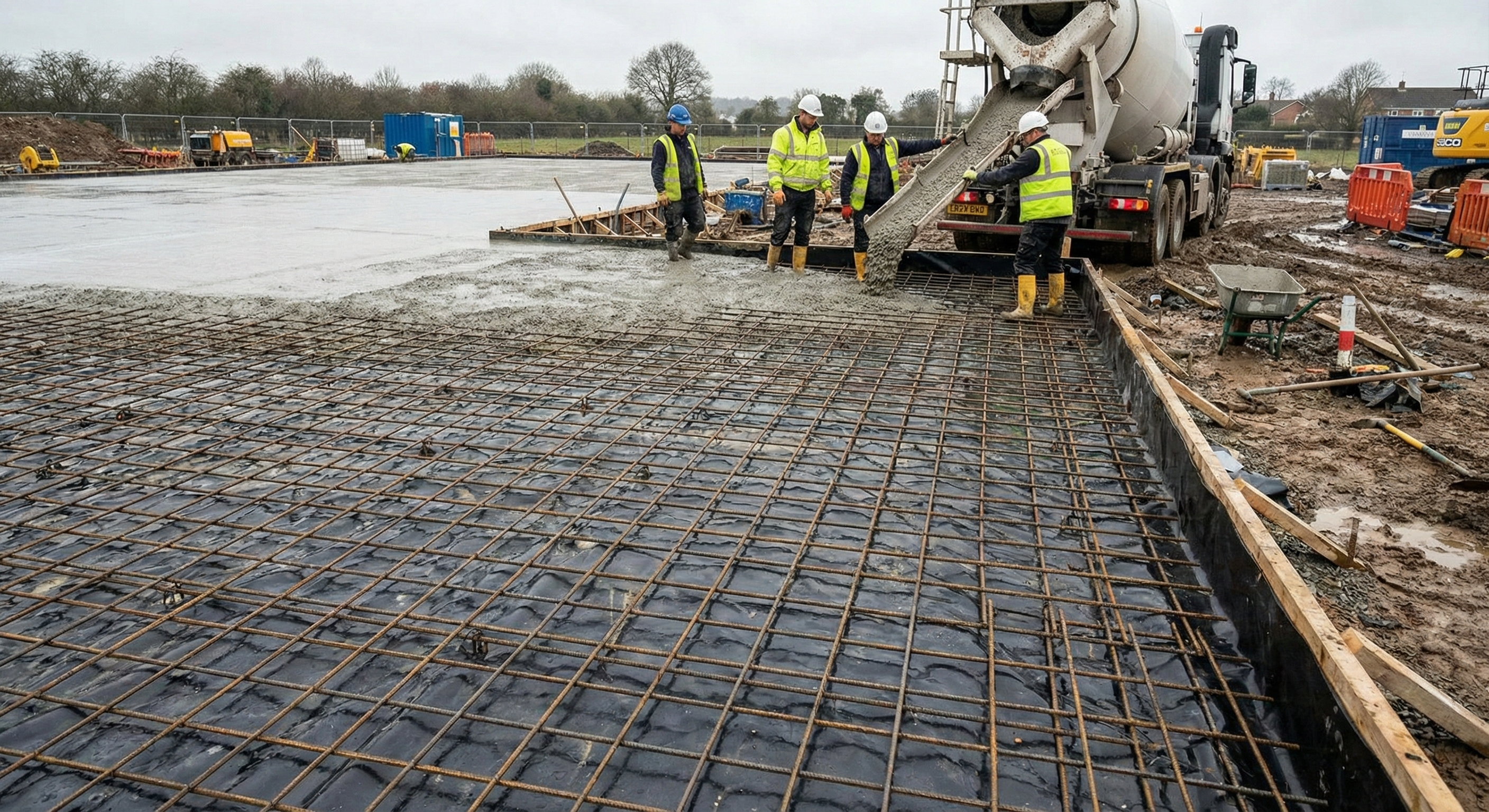
In the clay zones, we utilize Clayboard void formers under reinforced concrete slabs. This creates a collapsible void that allows the soil to expand without lifting your building.
In the southern chalk zones, we can often utilize deep bore soakaways for efficient stormwater disposal, as the ground is naturally permeable.
Urban Water Management
Croydon's high density means surface water has nowhere to go. Areas near the River Wandle (Waddon) and concrete-heavy zones face high flood risks. We implement high-capacity urban drainage solutions (SUDS) to satisfy planning conditions.
Attenuation Tanks
We install large underground geocellular crates (attenuation tanks) under car parks or driveways to hold storm surges and release water slowly into the Croydon sewer network.
Basement Waterproofing
For urban basements, we use a dual-system approach: Type B (waterproof concrete) combined with Type C (cavity drain membranes) to guarantee dryness in high-density areas.
Commercial Slabs
We pour power-floated reinforced concrete slabs for commercial units and warehouses along the Purley Way and industrial estates.
Planning Resources
Croydon Council
Access the planning portal for applications, building control, and conservation areas.
Visit Portal →Flood Risk Map
Check long-term flood risk, specifically surface water risks in CR0/CR9.
Check Postcode →Thames Water
Developer services for build-over agreements and commercial sewer connections.
Developer Services →